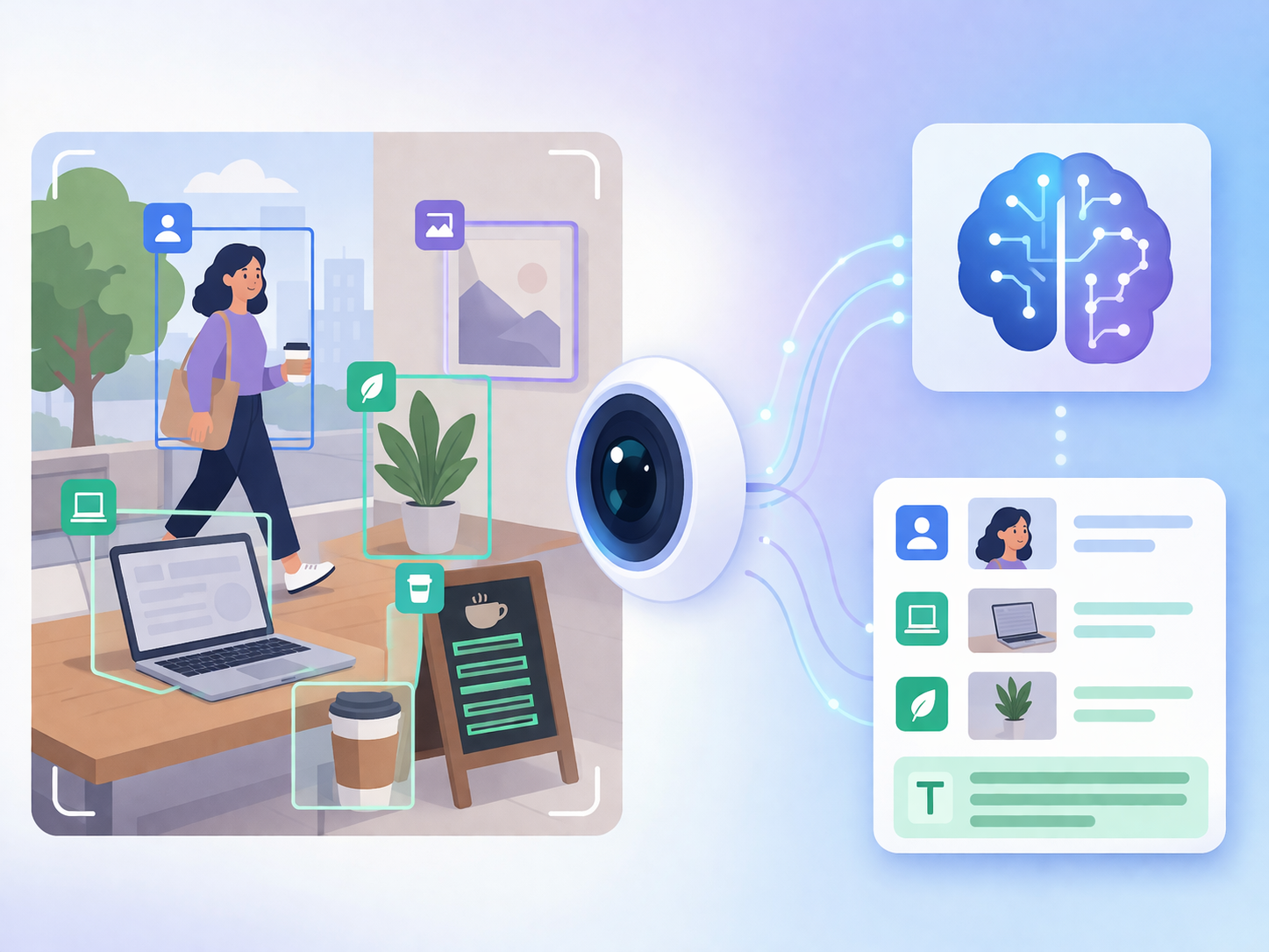
Vision Recognition in Action: How AI “Sees” the World
One of the most compelling capabilities of AI is how it interprets visual information — encompassing computer vision, object and label detection, optical character recognition, and contextual image understanding, all working together in real time.
One of the most compelling capabilities of AI is how it interprets visual information — encompassing computer vision, object and label detection, optical character recognition, and contextual image understanding, all working together in real time.
What Are Convolutional Neural Networks (CNNs)?
CNNs are a type of deep learning algorithm designed to process and analyse visual data. They use layers of convolutional filters to scan images, detecting features like edges, textures, and shapes. These features are combined to recognise complex patterns and classify image content.
CNNs are the backbone of modern computer vision systems, trained on large labeled datasets using supervised learning.
Real-World Case Study: AI for Accessibility
Microsoft’s Seeing AI app
Microsoft’s Seeing AI app uses computer vision to help blind or low-vision users navigate the world — reading text aloud, recognising faces and emotions, and describing scenes using the same underlying vision APIs. This shows how AI can create deeply human-centered applications that extend independence and dignity.
Try It Yourself
Google Cloud Vision Drag-and-Drop
- try object detection
- face detection
- text detection (OCR)
- SafeSearch
Microsoft Azure Computer Vision Playground
- try object detection
- image description
- text reading
- tags and categories
- celebrity and landmark recognition
Tips
- look for confidence scores above 80% as indicators of higher accuracy;
- keep image sizes manageable (~1MB or less);
- think critically about AI mislabeling implications in real-world use.
Ready to Put This Into Practice?
It's time to play with these hands on experiments designed to help you apply what you learned
Browse Experiments