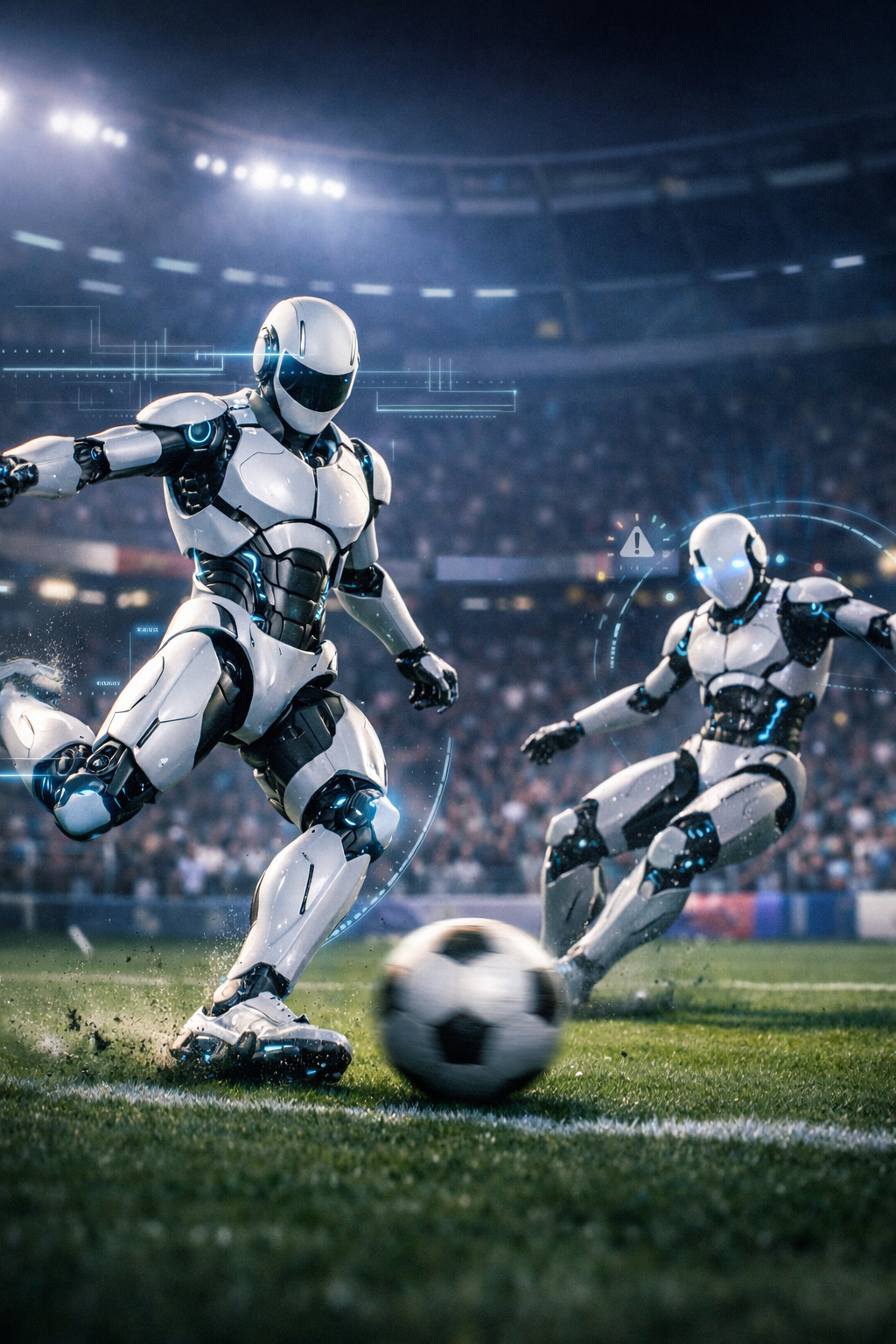
When Robots Play Football: A Glimpse into Our Autonomous Future
The world witnessed something both charming and significant: humanoid robots playing football in an exhibition match in China. The game clumsy, chaotic, and at times hilarious wasn’t about the score. It was about the technology, the autonomy, and the questions it raises about the role of AI and robots in human domains like sport.
Not Remote-Controlled — Autonomous
These robots operated independently, relying on four technologies running simultaneously, on-board, in real time:
Computer Vision
Seeing and interpreting the environment in real time
Sensor Fusion
Combining data streams from multiple sensors simultaneously
Machine Learning
Adapting and improving from every failure on the field
Path Planning
Deciding in real time how to move toward a goal
In robotics, failure is feedback. Each fall improves the balance algorithm. Every mistimed kick is part of the training loop.
Real-World Applications of the Same Technology
The same systems powering a robot to chase a football are already being applied in places that matter far more.
Search and Rescue
Navigating rubble and uneven terrain autonomously where humans can’t safely go.
Healthcare Assistants
Performing precise, mobile tasks in hospitals where accuracy and reliability are critical.
Space Exploration
Robots acting independently in environments too distant or dangerous for human intervention.
Smart Manufacturing
Collaborative robots (“cobots”) working alongside humans on factory floors.
The Big Question
The real test isn’t just whether robots can play football — it’s whether we want to watch them play.
Humans love sport for the drama, the emotion, and the unpredictability of human error and brilliance. A robot falling over is interesting. A human falling over and getting back up is something else entirely.
Just because we can automate doesn’t mean we always should — especially in areas where human authenticity is the point.
What This Raises
- What do we value in play, in performance, in humanity?
- It’s not just about capability — it’s about connection.
- How can we design AI that respects and enhances those values rather than replacing them?
Ready to Put This Into Practice?
It's time to play with these hands on experiments designed to help you apply what you learned
Browse Experiments