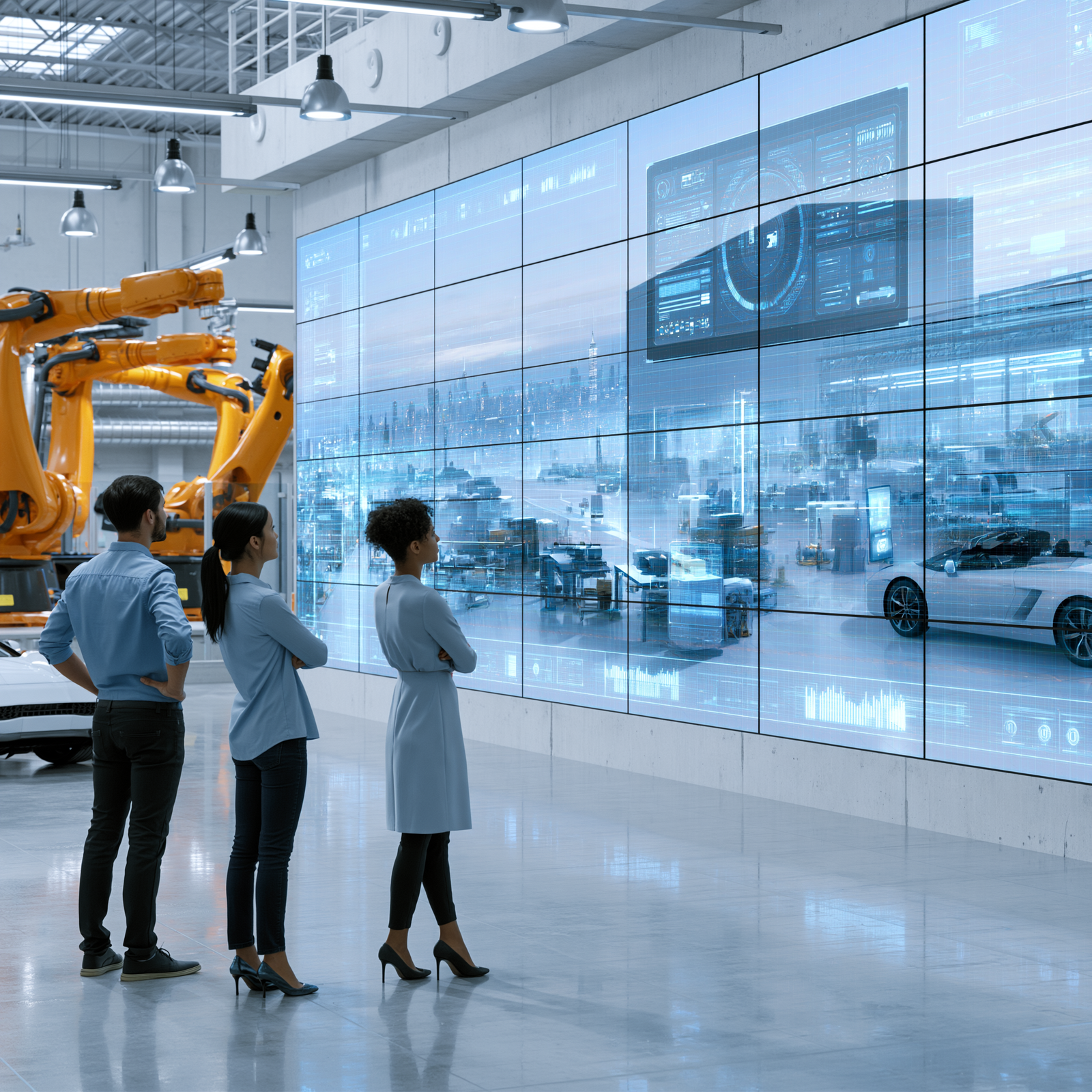
Digital Twins
Imagine having a virtual replica of a factory, a city, or even yourself — one that evolves, learns, and predicts outcomes before they happen.
What Is a Digital Twin?
A real-time virtual model that mirrors physical assets, processes, or even human behaviours.
Analyse
Scenarios before committing
Test
Optimisations with zero risk
Predict
Failures before they occur
Made possible by the convergence of IoT, cloud computing, and AI — digital twins are becoming more sophisticated by the year.
How Businesses Are Leveraging Digital Twins
Four industries showing what’s already possible today.
Automotive and Aerospace
Rolls-RoyceLeverages digital twins to optimise jet engine performance, predict maintenance needs, and reduce downtime — before a single part is physically inspected.
Healthcare and Personalised Medicine
Hospitals and biotech firms are developing patient digital twins to test drug interactions, customise treatments, and improve surgical outcomes — without touching the patient first.
Telecommunications and Cloud
Service providers use AI-driven digital twins to predict network congestion, automate maintenance, and optimise resource allocation — improving service reliability and customer experience.
Smart Cities
Virtual SingaporeSingapore has built one of the world’s first nationwide digital twins — a 3D model allowing planners to simulate traffic, model energy use, and test infrastructure changes before any physical work begins.
The principle is the same at every scale: build a model, feed it real data, and use it to make better decisions before committing to action.
What’s Next: AI-Native Digital Twins
Today
Passive Models
Mirroring physical assets and responding to queries
Tomorrow
AI-Native Decision Systems
Continuously learning, adapting, and automating processes independently
The Bigger Picture
- Digital twins shift decision-making from reactive to predictive — acting on what’s likely to happen, not what already has.
- As AI advances, the twin stops being a mirror and becomes a co-pilot — one that learns, adapts, and acts.
- The question isn’t whether your industry will use digital twins. It’s whether you’ll be shaping how they’re used.
Ready to Put This Into Practice?
It's time to play with these hands on experiments designed to help you apply what you learned
Browse Experiments