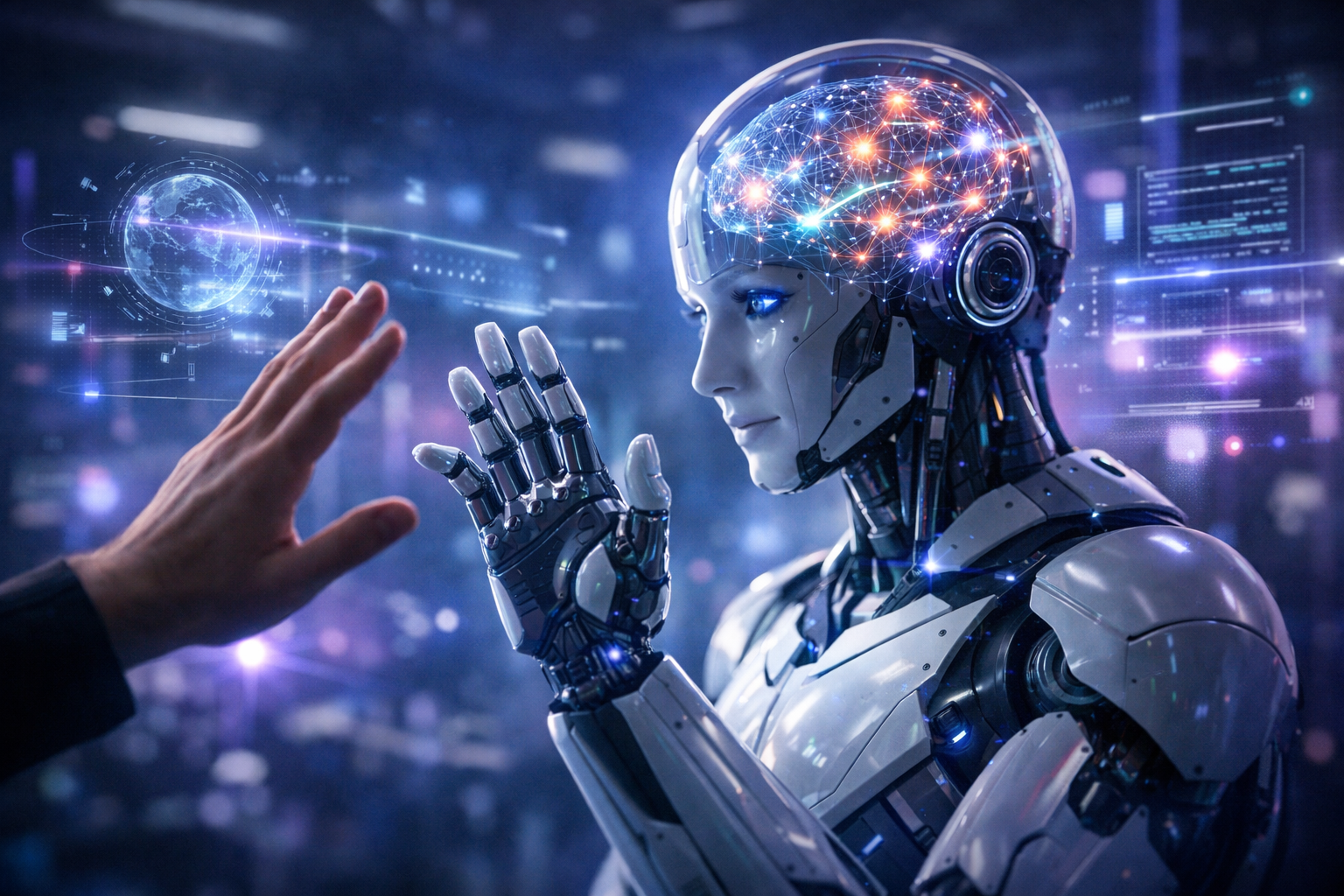
The Singularity
“Our technology, our machines, are part of our humanity. We created them to extend ourselves, and that is what they are doing. They are an extension of us.”
— Ray Kurzweil
After reading The Age of Spiritual Machines in 2000, I was fascinated by Kurzweil’s vision of human and machine convergence. It has stayed with me ever since — not just as a prediction about technology, but as a provocation about what it means to be human.
The Singularity: Kurzweil’s Vision
Kurzweil has long predicted a moment when machine intelligence will surpass human intelligence exponentially. His timeline is specific — and closer than most people realise.
2000
The Age of Spiritual Machines published
Kurzweil maps the trajectory of human-machine convergence and lays out the case for the Singularity.
2029
AI reaches human-level intelligence
Kurzweil predicts AI will pass the Turing Test — holding conversations indistinguishable from a human’s.
2045
Full human-machine integration
Cognitive abilities amplified by AI, empowering us to solve complex problems in ways we cannot yet imagine. The Singularity.
Beyond Intelligence: Medicine, Aging, and Ethics
Personalised Medicine
AI facilitates treatments tailored to the individual — moving away from one-size-fits-all healthcare.
Reversing Aging
Kurzweil’s optimism extends to extending human lifespans — with AI accelerating breakthroughs in longevity science.
“The best way to avoid destructive conflict in the future is to continue the advance of our ethical ideals.”
— Ray Kurzweil
These words align closely with a belief I keep returning to: we must democratise technological access and engage diverse voices to shape an inclusive, responsible future. Power without participation isn’t progress.
The Questions Worth Sitting With
- How do we embed our values into the technologies we create and adopt?
- How will we, as a global society, measure progress — not just by what we achieve, but by how those achievements uplift and empower us all?
Go Deeper
Ready to Put This Into Practice?
It's time to play with these hands on experiments designed to help you apply what you learned
Browse Experiments